Key takeaways
- Abandoned cart messages on WhatsApp must go to shoppers who opted in to receive WhatsApp messages.
- Cart reminders are usually marketing templates, charged by Meta at approximately ₹0.58 per message in India (subject to change).
- A common flow is a reminder about 1 hour after abandonment, a follow-up after about 24 hours and an optional incentive after that.
- Chatbox AI's native Shopify integration can trigger WhatsApp messages from 'Cart Abandoned' and 'Order Placed' events.
- Customer replies to a cart reminder open a 24-hour window for free-form help, where questions about size, delivery or COD can be answered.
Most online shoppers who add items to their cart leave without buying. Some were comparing prices, some got interrupted, some had a question nobody answered. Email reminders reach a fraction of them. WhatsApp reaches them in the app they check all day, and lets them reply with the question that stopped them.
This playbook explains how to set up WhatsApp abandoned cart recovery properly: consent, timing, templates, incentives, follow-up and measurement.
Why does WhatsApp work so well for cart recovery?
- It gets seen. Chatbox AI cites a 98% open rate for WhatsApp, compared with around 20% for email.
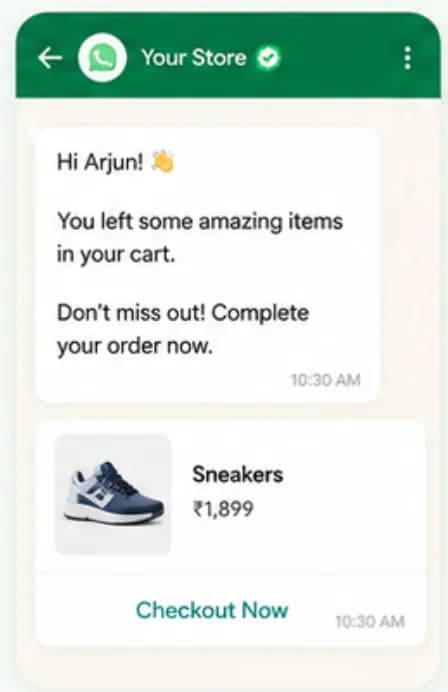
- It is visual. A product image and a one-tap checkout button bring the shopper right back.
- It is two-way. "Is this available in XL?" or "Can I pay cash on delivery?" can be answered instantly, which is often the real reason for abandonment.
- It suits Indian shoppers. UPI links, COD confirmation and regional-language messages all fit naturally.
"Cart recovery campaigns on Chatbox AI are printing money for us right now!" - Neha Gupta, Operations Manager, FreshCart
What do you need before you start?
- The WhatsApp Business API connected through a platform like Chatbox AI. See What is the WhatsApp Business API?
- Opt-in at checkout. Shoppers must agree to receive WhatsApp messages from you, typically an unticked checkbox next to the phone field. See WhatsApp opt-in rules.
- A store integration that captures the cart and phone number when checkout starts. Chatbox AI integrates natively with Shopify and Shopify checkouts; other stores can use webhooks and APIs.
- Approved templates for each step of the flow.
What does a high-converting cart recovery flow look like?
| Step | Timing | Message | Goal |
|---|---|---|---|
| 1 | About 1 hour after abandonment | Friendly reminder with product image and checkout button | Catch distracted shoppers |
| 2 | About 24 hours later | Social proof or benefits, plus "Need help?" button | Address hesitation |
| 3 | About 48–72 hours later (optional) | Time-limited incentive for higher-value carts | Convert price-sensitive shoppers |
Stop the flow as soon as the order is placed. Chatbox AI automation can listen for Shopify "Order Placed" events and exit the shopper from the sequence automatically.
Why about one hour?
Too soon feels intrusive; too late and the intent has faded. The standard abandoned cart use case in Chatbox AI automation sends a reminder one hour after checkout abandonment, which is a good starting point to test from.
What should cart recovery templates say?
Cart reminders are generally marketing templates. Keep them short, personal and visual.
Reminder 1: the gentle nudge
Header: product image
Hi
{{1}}, you left{{2}}in your cart. It is still waiting for you, complete your order in one tap.Button: Complete my order
Reminder 2: remove doubt
Hi
{{1}}, still thinking about{{2}}? Free delivery on this order and easy returns. Have a question? Just reply here.Buttons: Complete my order · I have a question
Reminder 3: the incentive (optional)
Hi
{{1}}, here is{{2}}off your cart, valid for the next 24 hours. Use code{{3}}at checkout.Button: Claim my offer
Tips:
- Use the actual product image as the header.
- Mention delivery date, COD availability or return policy if those are common objections.
- Add a "Talk to us" quick reply so shoppers can ask questions instead of leaving.
- Include an opt-out option on marketing messages.
How should you use discounts?
Discounts recover sales but cost margin. A balanced approach:
- No discount in step 1. Many shoppers just need a reminder.
- Value, not price, in step 2. Free shipping, easy returns, reviews.
- Discount only in step 3, and only for carts above a threshold or for first-time customers.
- Unique or expiring codes prevent coupon sharing.
Test with and without incentives and compare recovered revenue minus discount cost.
What happens when the shopper replies?
A reply opens a 24-hour customer service window, during which you can send free-form messages and service replies are free. This is where many sales are actually won.
- A no-code chatbot can answer common questions, sizes, delivery time, payment options, instantly.
- Complex questions go to a human in the team inbox with the full chat history.
- Agents can send product details or a payment link directly in the chat.
How do you reduce COD returns with WhatsApp?
Cash on delivery is popular in India but increases return-to-origin (RTO) when buyers change their minds. Add a COD confirmation step after the order:
- Order placed with COD.
- WhatsApp message: "Please confirm your order of
{{1}}for{{2}}" with Confirm and Cancel buttons. - Confirmed orders ship; cancelled ones are stopped before dispatch; no response triggers a reminder or a call.
- Optionally offer a prepaid discount via a UPI or payment link.
Chatbox AI's Shopify integration supports COD confirmation to help reduce RTO.
How do you measure cart recovery performance?
| Metric | How to calculate |
|---|---|
| Recovery rate | Orders recovered ÷ carts that received a reminder |
| Recovered revenue | Total value of recovered orders |
| Revenue per message | Recovered revenue ÷ reminders sent |
| Cost per recovery | (Meta charges + discount cost) ÷ recovered orders |
| Opt-out/block rate | Opt-outs ÷ reminders sent |
Meta charges approximately ₹0.58 per marketing message in India according to Chatbox AI's pricing page: rates change, so check the current rate card. Compare that to your average order value; the maths usually works strongly in WhatsApp's favour. Chatbox AI analytics include revenue attribution on the Growth plan and above.
What should you A/B test first?
Once the flow is live, improve it one variable at a time:
- Timing of the first reminder: for example 30 minutes vs 1 hour vs 3 hours.
- Header: product image vs short product video.
- Copy angle: plain reminder vs scarcity ("only a few left in your size") where it is true.
- Buttons: "Complete my order" alone vs adding "I have a question".
- Incentive: free shipping vs percentage discount vs no incentive.
- Language: English vs Hindi or a regional language for relevant segments.
Run each test long enough to see a real difference in recovered orders, not just clicks, and keep the winner as your new baseline.
What mistakes should you avoid?
- Messaging shoppers who never opted in.
- Sending more than three reminders.
- Continuing the flow after the order is placed.
- Generic text with no product image.
- Leading with a discount every time.
- Leaving replies unanswered.
How do you set it up with Chatbox AI and Shopify?
- Start a free trial and connect your WhatsApp number.
- Install the Shopify integration and enable WhatsApp opt-in at checkout.
- Create and submit your three cart recovery templates, plus order confirmation and shipping updates.
- In automation, trigger the sequence on "Cart Abandoned" with your chosen delays, and exit on "Order Placed".
- Set up chatbot answers for the top five pre-purchase questions.
- Review recovered revenue weekly and test timing, copy and incentives.
For the wider e-commerce picture, see our e-commerce solution and the D2C brands in India guide.
Start recovering carts this week
Cart recovery is usually the fastest WhatsApp automation to pay for itself: the shoppers already chose products, and you are simply helping them finish. Start your 7-day free trial of Chatbox AI, no credit card required, and switch on your first recovery flow today.
Frequently asked questions
Yes, as long as the shopper opted in to receive WhatsApp messages from your business and you use an approved template. Collecting opt-in at checkout, before the cart is abandoned, is the most common approach.
Is it allowed to send abandoned cart messages on WhatsApp? Yes, as long as the shopper opted in to receive WhatsApp messages from your business and you use an approved template. Collecting opt-in at checkout, before the cart is abandoned, is the most common approach.
Are abandoned cart reminders utility or marketing messages? They are generally treated as marketing, especially if they include offers or encourage a purchase. Categorise them honestly; Meta can re-categorise templates that do not match.
How many cart reminders should I send? Two or three at most. A first reminder, a follow-up and, optionally, a final incentive. More than that tends to annoy shoppers and increases blocks.
Should I always offer a discount? No. Many shoppers just got distracted and complete the purchase with a simple reminder. Reserve discounts for a later step or higher-value carts so you do not train customers to abandon on purpose.
Does WhatsApp cart recovery work for COD orders? Yes. Beyond cart recovery, WhatsApp can confirm cash-on-delivery orders before dispatch, which helps reduce return-to-origin. Chatbox AI supports COD confirmation flows with Shopify.